
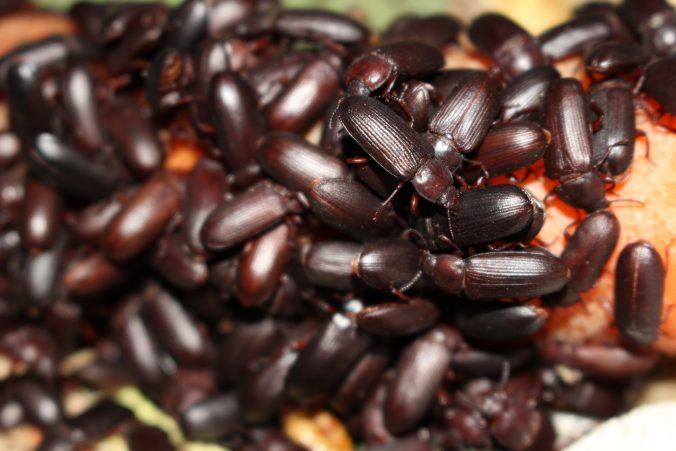
At Kodiak Bones & Bugs, we know dermestid beetles best as remarkable workers. A healthy colony of Dermestes maculatus can clean tissue from skulls and skeletons while preserving delicate bone structures that can be damaged by boiling or aggressive manual cleaning. But dermestids are more complex than their familiar role in taxidermy might suggest.
Recent natural-history observations have raised an interesting question: do dermestid beetles pollinate flowers? Adult Dermestes beetles have been photographed inside several types of flowers, and some individuals appear to be carrying pollen. The connection is worth exploring, but it is also important not to make a broader claim than the evidence supports.
Our view is straightforward: there is likely some relationship between flowering plants and certain life stages or species of dermestids, but the interaction may be direct, indirect, or simply associative. A dermestid found on a flower is not automatically a proven pollinator.
Why Are Dermestid Beetles Found on Flowers?
Insects visit flowers for many reasons. Nectar and pollen are obvious possibilities, but flowers can also provide warmth, shelter, moisture, a place to find mates, or chemical scents that resemble another resource. An insect may enter a flower without feeding from it or contributing to its reproduction.
This distinction is especially relevant for dermestids. These beetles are strongly associated with dried animal material and decomposition. Some unusual flowering plants attract insects by producing odors that imitate carrion or dung. To a beetle searching for decaying organic matter, a foul-smelling flower may seem worth investigating even when it offers no animal tissue.
One striking example is Hydnora africana, a parasitic plant native to southern Africa. Most of the plant grows underground, while its fleshy flower emerges above the soil and produces a carrion-like odor. The flower temporarily traps visiting insects and later releases them after pollen has been presented.
A 2009 study of Hydnora africana found that Dermestes maculatus accounted for 76.9% of the insects held inside the flowers examined at the study site. That is a substantial association and gives researchers a reasonable basis for asking whether dermestids help move pollen between these flowers.
Flower Visitation Is Not the Same as Pollination
A photograph of a beetle inside a flower can prove that the visit happened. Visible pollen on the beetle can show that contact occurred. Neither observation, by itself, demonstrates effective pollination.
For an insect to function as a pollinator, it generally must pick up viable pollen, carry it to another compatible flower, place it on a receptive stigma, and contribute to fertilization or seed production. Researchers may need repeated field observations, examination of pollen loads, exclusion experiments, or other controlled studies to establish that complete chain of events.
This is why careful language matters. It may be accurate to describe an adult dermestid as a flower visitor or a potential pollen carrier. Calling dermestids direct pollinators as a group would go beyond what the current evidence can support.
What Other Dermestid Observations Tell Us
The observations collected by Dermestaria show that the Hydnora example is not completely isolated. Several Dermestes species have been photographed inside the foul-smelling flowers of Hydnora and Dracunculus plants in different parts of the world. Other dermestids have been photographed on more conventional flowers with pollen visible on their bodies.
These records suggest that flower use may vary among dermestid species. Some adults may be responding to carrion-like odors. Others may be feeding on pollen or another plant material, resting on flowers, or taking advantage of a resource we do not yet understand. In a few specialized plant systems, pollen transport may be part of the relationship.
The family Dermestidae includes many species with different life histories. Evidence involving one species, one life stage, or one unusual flower should not automatically be applied to every dermestid. This is particularly important when discussing Dermestes maculatus, the species commonly maintained in colonies for skeletal preparation.
Our Perspective as Dermestid Beetle Keepers
Working with dermestids teaches you quickly that their behavior depends on life stage, available food, temperature, humidity, colony conditions, and the surrounding environment. The larvae do most of the tissue-cleaning work, while adult beetles reproduce and maintain the colony. What a wild adult beetle does outdoors does not necessarily tell us what a larva needs inside a managed colony.
We find the flower observations fascinating because they reveal another side of insects most people know only as flesh-eating beetles. At the same time, we would not use these reports to change established colony-care practices or to describe dermestids broadly as pollinators.
A working colony should still be kept in a secure enclosure with suitable animal-based food, stable temperatures, controlled moisture, ventilation, and protection from mites and outside pests. There is no practical reason to add flowers to a skull-cleaning colony based on sightings of wild adults. Captive beetles should also remain contained rather than being released to observe how they interact with local plants.
So, Do Dermestid Beetles Pollinate Flowers?
Certain Dermestes beetles clearly visit flowers. Some have been documented inside plants that use carrion-like odors to attract insects, and others have been photographed with pollen on their bodies. Those facts make pollen transport possible and justify further scientific study.
What they do not establish is that dermestids are regular, effective pollinators across the family. The safest conclusion is that some dermestid species have meaningful associations with certain flowering plants, while the exact ecological role of those visits remains uncertain.
Flowering plants have existed alongside insects for an extraordinarily long time, so it is not surprising that many insect species use them in one way or another. Whether a particular Dermestes species visits for scent, shelter, food, or pollen – and whether the plant benefits – has to be evaluated case by case.
For us, that uncertainty makes the subject more interesting, not less. Dermestid beetles are already essential tools for precise skull cleaning and skeletal preparation. Their possible relationships with flowers are a reminder that even insects we work with every day still have behaviors left to understand. Learn more about healthy dermestid beetle colonies or review our dermestid beetle FAQs for practical colony-care guidance.